


When it comes to personal gas detection in hazardous environments, the MSA ALTAIR 4XR and MSA ALTAIR io 4 are two of the most reliable devices on the market. Both are 4-gas detectors designed to monitor LEL (Lower Explosive Limit), O₂ (oxygen), CO (carbon monoxide), and H₂S (hydrogen sulfide). Despite their similar core functionality, these devices differ in several key areas — battery life, weight, and above all, connectivity. This guide breaks down the differences so you can pick the right detector for your crew.

MSA ALTAIR 4XR
The proven 4-gas workhorse — 24-hour runtime, Bluetooth, 4-year warranty.
Shop ALTAIR 4XR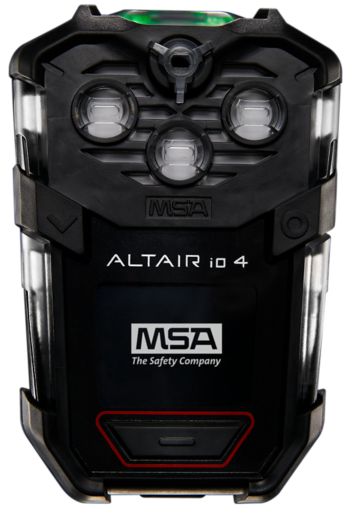
MSA ALTAIR io 4
The connected wearable — LTE, GPS, and real-time visibility through MSA Grid.
Shop ALTAIR io 4ALTAIR 4XR vs. ALTAIR io 4: Comparison Chart

| Feature | ALTAIR 4XR | ALTAIR io 4 |
|---|---|---|
| Typical Configuration | 4-Gas (LEL, O₂, CO, H₂S) | 4-Gas (LEL, O₂, CO, H₂S) |
| Battery | Rechargeable | Rechargeable |
| Charge Time | 4 hours | 4.5 hours |
| Run Time | 24 hours | 17 hours |
| Weight | 8 oz. | 9 oz. |
| Datalogging | >50 hours / >500 events | 90-day cloud-synced data logs |
| Warranty | 4 years | 4 years — unlimited with subscription |
| Connectivity | ||
| Real-time Remote Connectivity | No | Yes |
| RFID Enabled | No | Yes |
| LTE (Cellular) | No | Yes |
| Bluetooth | No | Yes |
| Location Awareness (GPS) | No | Yes |
| GPS Accuracy | n/a | 8 ft. |
| MSA Grid Capable | No | Yes |
| Calibration | ||
| Allows Manual Calibration | Yes | Yes |
| Docking Station Calibration | Yes | Yes |
| Durability | ||
| Drop Test (MIL-STD-810G) | Yes | Yes |
| Water & Dust Proof (IP68) | Yes | Yes |
| 60-Minute Tumble Test | No | Yes |
Core Features: What They Share
Both the ALTAIR 4XR and the ALTAIR io 4 run a typical 4-gas configuration — LEL, O₂, CO, and H₂S — making either suitable for confined space entry, construction, oil & gas, utilities, wastewater, and manufacturing. Both share MSA's signature ruggedness:
- MIL-STD-810G drop tested — each survives repeated 4-foot drops; the 4XR is rated to survive a 25-foot drop, and the io 4 adds a 60-minute NFPA 1982-2018 tumble test.
- IP68 dust- and waterproof — submersion-rated so a drop in standing water doesn't end the shift.
- Fast XCell® sensors — rapid response and quick span calibrations, with both manual and docking-station calibration supported.
- Glove-friendly operation — big buttons and bright, readable displays.
Where They Differ
Battery Life & Weight — Advantage: 4XR
The 4XR runs 24 hours on a charge (vs. 17 for the io 4), charges faster, and is an ounce lighter. For long shifts, overtime, and crews that don't dock devices nightly, the 4XR's endurance is hard to beat.
Connectivity & Visibility — Advantage: io 4
This is the io 4's reason for existing. Built-in LTE cellular, Bluetooth, RFID, and GPS accurate to 8 feet (updated every 30 seconds) feed the MSA Grid cloud platform, giving safety managers real-time visibility into every worker's gas readings, alarms, and location — no phone pairing or gateway required. Data logs sync to the cloud automatically with 90-day retention, and with an active subscription the warranty becomes unlimited, with software updates delivered over the air.
Fleet Management
The 4XR handles compliance the traditional way: onboard datalogging (50+ hours, 500+ events) you download at the dock. The io 4 removes the manual step entirely — records land in MSA Grid on their own, which pays off fast across large fleets or multiple job sites.
Which Should You Choose?
Choose the ALTAIR 4XR if:
- You prioritize longer battery life for extended shifts.
- You want a lighter, no-frills device at a lower cost of entry.
- You need dependable gas detection without subscriptions or cellular coverage requirements.
Choose the ALTAIR io 4 if:
- You work in a high-risk, tech-enabled environment.
- You require real-time tracking, LTE, GPS, and Bluetooth.
- You want seamless integration with modern connected-safety systems like MSA Grid.
Frequently Asked Questions
Do the ALTAIR 4XR and io 4 detect the same gases?
Yes — both run the standard 4-gas configuration: combustible gases (LEL), oxygen (O₂), carbon monoxide (CO), and hydrogen sulfide (H₂S).
Does the ALTAIR io 4 require a subscription?
The io 4 works as a gas detector on its own, but its connected features — MSA Grid live monitoring, cloud data logs, over-the-air updates, and the unlimited warranty — are tied to an active subscription.
Which detector lasts longer on a charge?
The ALTAIR 4XR — 24 hours of runtime versus 17 hours for the io 4, and it recharges in about 4 hours.
Can both be calibrated the same way?
Yes. Both support manual calibration and automated docking-station calibration. If a calibration fails, see our interactive ALTAIR Calibration Failure Troubleshooter for step-by-step help.
Conclusion
Both gas detectors offer rugged, reliable protection tailored to different job environments. The ALTAIR 4XR is the dependable choice for straightforward, long-shift applications. The ALTAIR io 4 adds smart features and real-time connectivity that shine in complex or large-scale operations. Whichever you choose, both deliver industry-trusted protection where it matters most.
Not sure which fits your fleet?
Jendco Safety Supply — family-owned in Columbus, Ohio since 1989. We'll help you spec the right detectors, kits, and gas.
